Rapid Refresh Forecast System and RRFS Ensemble Forecast System Output Availability
The NSF Unidata Program Center is pleased to announce the availability of Rapid Refresh Forecast System (RRFS) and RRFS Ensemble Forecast System (REFS) output in NSF Unidata datastreams. The six new datasets available from NOAA via NOAAPORT are:
- Rapid Refresh Forecast System (RRFS)
- North America 3 km
- North America 13 km
- RRFS Ensemble Forecast System (REFS) (statistics-only)
- CONUS 3 km
- Alaska 3 km
- Hawaii 2.5 km
- Puerto Rico 2.5 km
The RRFS and REFS replace the now decommissioned North American Model (NAM), Short Range Ensemble Forecast (SREF), High Resolution Ensemble Forecast (HREF), and High-Resolution Window (HiresW) Forecast systems. Details can be found in the latest Service Change Notice update (SCN 26-48 Update) More information about these models can be found on the NOAA Global Systems Laboratory website.
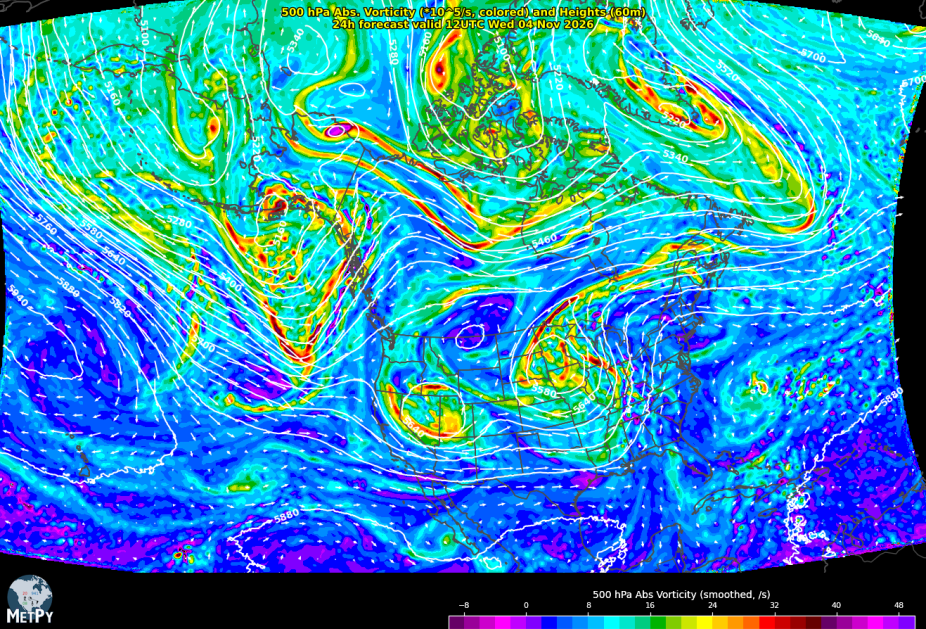
Plot of 500 hPa absolute vorticity field and heights using Python and output from the RRFS 13 km North American domain valid 12z November 4th 2026 (from the 12z November 3rd run).
Pete Pokrandt, University of Wisconsin–Madison, Department of Atmospheric and Oceanic Sciences
Dataset Structure and Sizes
The RRFS and REFS output are transmitted across NOAAPORT four times daily (at 0, 6, 12, and 18Z). RRFS is output every 3-hours up to a forecast of 60-hours, then every 6-hours out to 84 hours. REFS is output is available out to 60-hours. REFS datasets include statistical fields derived from the ensemble members, but not the ensemble members themselves. Regarding dataset size, RRFS runs are approximately 3.8 GB for the 3 km grid, and 850 MB for the 13 km grid; REFS runs are between 40 MB and 1 GB, depending on the domain.
Availability Timeframes
Grids from the RRFS and REFS begin to arrive across the SBN approximately 1.5 hours after the run begins, and take 1.5–2 additional hours to fully complete. REFS grids begin transferring 1.5–2 hours after the initial forecast time, and take roughly 2–2.5 additional hours to complete.
IDD Access
Six new datasets are available through the NSF Unidata Internet Data Distribution via the NGRID feed. The following are example pqact patterns that could be used by those with access to the NGRID feed:
| pqact snippets |
|---|
# RRFS North American 3 km NGRID ^Y.A... KWDA ([0-3][0-9])([0-2][0-9][0-6][0-9]) FILE RRFS_NA_3km_(\1:yyyy)(\1:mm)\1_\2.grib2 # RRFS North American 13 km NGRID ^Y.H... KWDA ([0-3][0-9])([0-2][0-9][0-6][0-9]) FILE RRFS_NA_13km_(\1:yyyy)(\1:mm)\1_\2.grib2 # REFS CONUS 3 km NGRID ^Y.[A-Q]... KWDB ([0-3][0-9])([0-2][0-9][0-6][0-9]) FILE REFS_CONUS_3km_(\1:yyyy)(\1:mm)\1_\2.grib2 # REFS Alaska 3 km NGRID ^A.[A-Q]... KWDB ([0-3][0-9])([0-2][0-9][0-6][0-9]) FILE REFS_Alaska_3km_(\1:yyyy)(\1:mm)\1_\2.grib2 # REFS Hawaii 2.5 km NGRID ^H.[A-Q]... KWDB ([0-3][0-9])([0-2][0-9][0-6][0-9]) FILE REFS_Hawaii_2p5km_(\1:yyyy)(\1:mm)\1_\2.grib2 # REFS Puerto Rico 2.5 km NGRID ^P.[A-Q]... KWDB ([0-3][0-9])([0-2][0-9][0-6][0-9]) FILE REFS_Puerto_Rico_2p5km_(\1:yyyy)(\1:mm)\1_\2.grib2 |
Remote access via the THREDDS Data Server
Remote access to the new datasets is provided alongside other IDD model datasets via the NSF Unidata THREDDS Data Server (TDS). Specifically:
- RRFS North America 3 km
- RRFS North America 13 km
- REFS CONUS 3 km
- REFS Alaska 3 km
- REFS Hawaii 2.5 km
- REFS Puerto Rico 2.5 km
These output are also available from the University of Wisconsin - Madison department of Atmospheric and Oceanic Sciences TDS (currently backed by output sourced from NOMADS, as these collections have been in place since before output were available on NOAAPORT).
Visualize the new output
The new RRFS model output is now available in CAVE if you are connected to Unidata's EDEX server! You can find a number of products in the models menu (Models → RRFS-North America) or all available products in the Volume Browser.
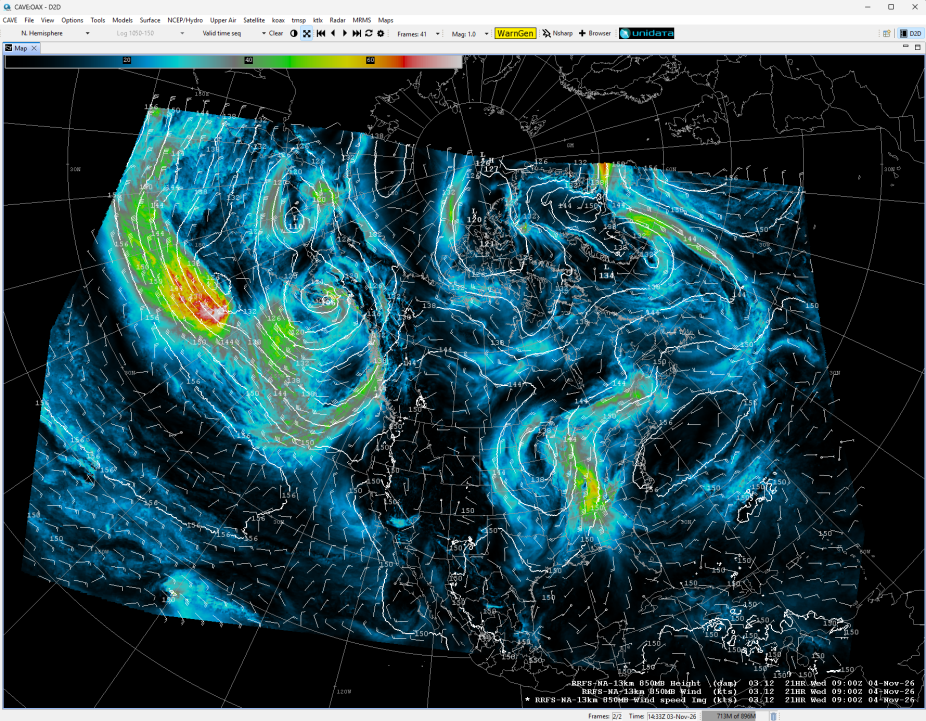
Display of 850 hPa velocity field, speed, and heights in AWIPS CAVE using output from the RRFS 13 km North American domain valid 9z November 4th 2026 (from the 12z November 3rd run).
If you are using the IDV, the new model output are available in the default catalog under “Unidata Model Data → Forecast Model Data → Rapid Refresh Forecast System (RRFS)“ and "RRFS Ensemble Forecast System (RRFS).” IDV lead developer Yuan Ho has created a new bundle based on the IDV Sample bundle "NAM211: Isentropic Potential Vorticity" (as a reminder, the NAM has been discontinued and is replaced by RRFS). The new bundle can be accessed from within the IDV using the toolbar under “Bundles → Weather → Real Time Weather → RRFS Isentropic Potential Vorticity“ or downloaded from the NSF Unidata's RAMADDA data repository instance.
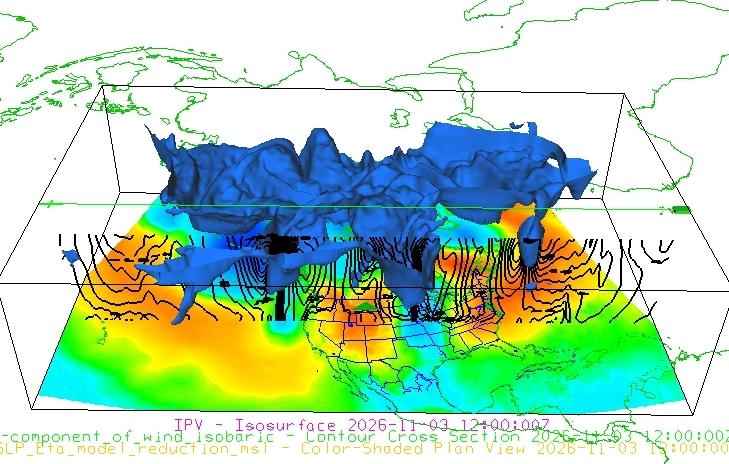
3D Isentropic Potential Vorticity (IPV) analysis in the Integrated Data Viewer using output from the RRFS 13 km (IPV isosurface and wind speed cross section) and the RRFS 3 km North American domain (Mean Sea Level Pressure) valid 12z November 3rd 2026 (from the 12z November 3rd run).
Special guest (and 2019 DeSouza Award Winner!) Pete Pokrandt from the University of Wisconsin - Madison Atmospheric and Oceanic Sciences department has put together a Jupyter Notebook demonstrating how to access RRFS data from the UW - Madison department of Atmospheric and Oceanic Sciences TDS. Pete's notebook includes the steps used to build the 850 hPa temperature and heights plot (left) and 500 hPa absolute vorticity field and heights (top) shown in this post!. See this Jupyter notebook for more details.
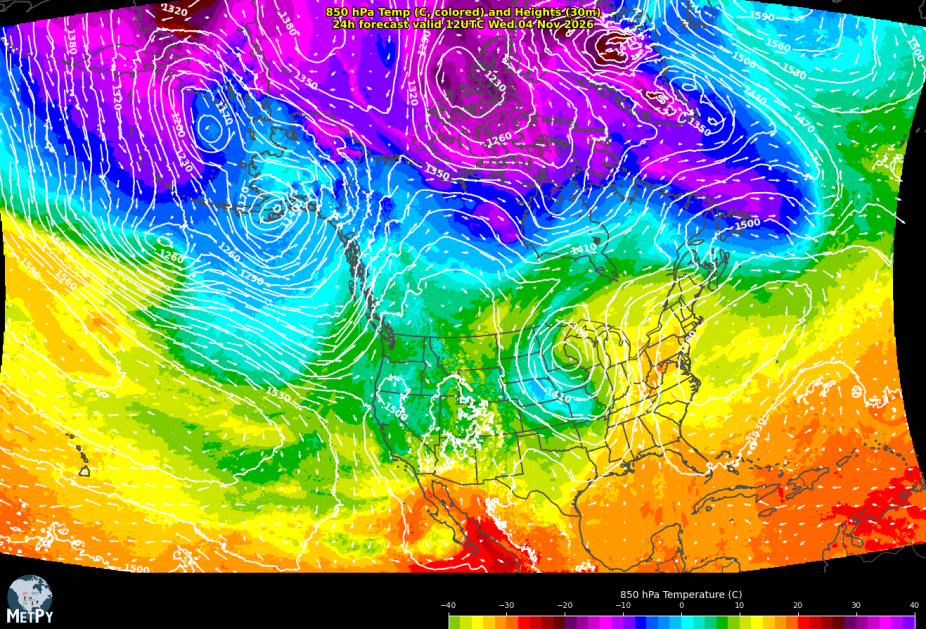
Plot of 850 hPa temperature and heights using Python and output from the RRFS 13 km North American domain valid 12z November 4th 2026 (from the 12z November 3rd run).
Pete Pokrandt, University of Wisconsin–Madison, Department of Atmospheric and Oceanic Sciences

Add new comment