Internet Data Distribution (IDD)
NSF Unidata's Internet Data Distribution network (IDD) is a system for disseminating near real-time Earth observations and prediction model output via the Internet. Unlike other systems, which are based on data centers where the information can be accessed, the IDD is designed so a university can request that certain data sets be delivered to computers at their site as soon as they are available from the observing system. The IDD system also allows any site with access to specialized observations to inject the dataset into the network for delivery to other interested sites.
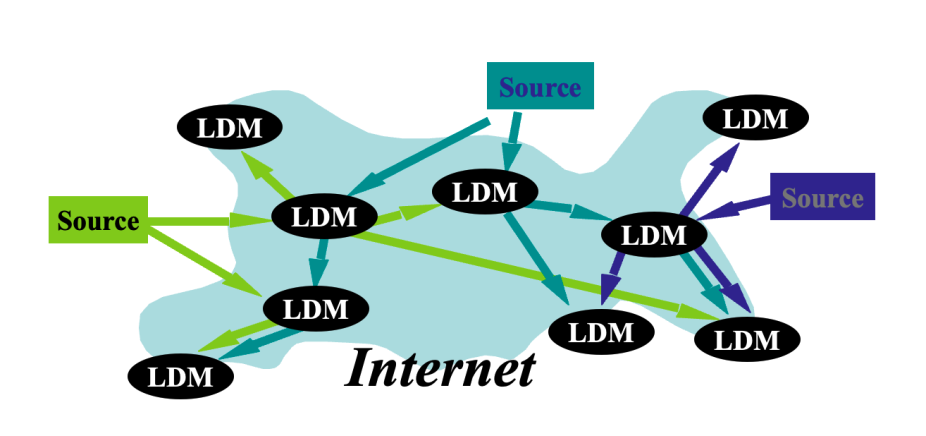
The IDD is composed of a network of cooperating installations of the NSF Unidata Local Data Manager (LDM). The LDM is a collection of cooperating programs that select, capture, manage, and distribute arbitrary data products. The system is designed for event-driven data distribution, where LDM installations receive data products from upstream nodes as soon as the products become available.
The IDD is designed to function as a peer-to-peer network, with any node being able to send data to and receive data from any other node. Agreements about data flow are concluded between nodes, with no central authority or oversight. While the IDD is robust and very reliable, users should note that the IDD is not considered "Operational" data since 24 hour support is not possible, and some data may be experimental in nature.
NSF Unidata operates a primary source node in the IDD network, and many sites receive data feeds directly from the Program Center's LDM. However, due to the NSF Unidata Program's funding mechanism and resource constraints, the Program Center limits connections to its LDM to universities. (Practically speaking, we only feed to host machines that have fully qualified and reverse DNS lookup addresses that end in .edu.)
If you are interested in receiving data via the IDD network, please read the following:
- If you are associated with a U.S. academic institution AND your LDM host resolves to a U.S.
.edudomain, contact us at support-idd@unidata.ucar.edu for assistance. - If you are NOT associated with a U.S. academic institution, you may be able to arrange for a data feed from an institution near you. The best way to find an institution willing to supply a feed is to make a request on the the LDM-users e-mail list*.
*WARNING: Legitimate US-based academic and scientific research requests for access to other IDD nodes are welcome. Requests for access to IDD feeds to support prediction-market analysis or other commercial purposes are not permitted, regardless of whether the activity is characterized as “research.” Such requests may result in removal and a ban from the list.
Note that a significant portion of the data available via IDD feeds is also available for remote data access via the NSF Unidata Program Center's THREDDS Data Server.
CONDUIT
The Cooperative Opportunity for NCEP Data Using IDD Technology (CONDUIT) program distributes high resolution model datasets made available by the NWS National Centers for Environmental Prediction (NCEP). CONDUIT data feeds are designed to be flexible to meet the needs of the user community, and therefore contents may change as necessary to reflect the availability of products from NCEP and the requirements of the recipients.