Evolution of the THREDDS Data Server
Origins and Vision
The THREDDS Data Server (TDS) grew out of NSF Unidata's THREDDS (Thematic Real-time Environmental Distributed Data Services) project, which emerged in the early 2000s to make distributed Earth system data easier to publish, discover, and access. Ben Domenico was a key early leader in shaping the THREDDS project and its broader vision, while John Caron and Ethan Davis played central roles in its technical development and implementation.
Building the Foundation
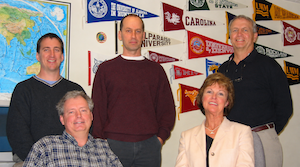
Top row, L-R: Ethan Davis, John, Caron, and Ben Domenico
Bottom row, L-R: Robb Kambric and Linda Miller
From the beginning, the THREDDS project was closely connected to the development of the netCDF-Java library and the Common Data Model (CDM). The CDM provides a common interface for working with a variety of scientific data formats and forms the foundation for many of the data access services provided by the TDS.
The project also emphasized the use of community data standards and conventions. Through the diligence of Ethan Davis and other developers, the TDS has supported widely used data formats, metadata conventions, and access protocols, helping make scientific data from different sources more interoperable and easier to discover, share, and use.
From Project to Platform
Early versions of the TDS were in use by the mid-2000s, with a stable version 3.4 release announced in 2005. Over time, the TDS evolved into an important platform for sharing and accessing real-time and archived Earth system data within the NSF Unidata community and beyond.
Modernization and Evolution
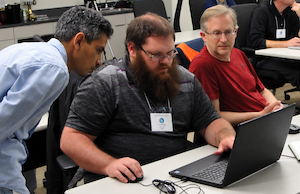
2018 TDS Training Workshop
Later development was shaped by Sean Arms, who led major modernization efforts for the TDS and related netCDF-Java/CDM software. Hailey Johnson subsequently served as project lead, guiding continued development and modernization of the TDS and netCDF-Java/CDM before Sean's return to NSF Unidata in late 2024.
More recent development has continued under Sean's leadership, building on this work with improvements in areas such as cloud and object-storage access, as well as exploration of a more sustainable architecture for a next-generation TDS that preserves compatibility with existing systems where possible.
The TDS Today
Developed and supported by NSF Unidata, the TDS remains an important part of the infrastructure used by researchers and educators to share and access real-time and archived Earth system data.